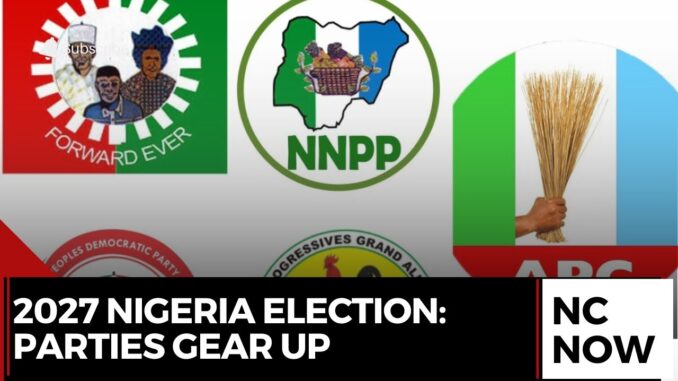

The Nigeria 2027 elections campaign has unofficially started in Lagos, Abuja, and across the country, despite being more than 18 months away from the actual polls—and electoral officials are not happy about it. From towering billboards endorsing President Bola Tinubu’s second term in the Federal Capital Territory to subtle coalition rallies in Port Harcourt, Kano, and Akure, Nigerian politicians have thrown caution to the wind and are openly violating the Electoral Act 2022. What we’re witnessing isn’t just political enthusiasm; it’s a calculated gamble that could reshape Nigeria’s democratic landscape and expose the weakness of our electoral institutions.
The numbers don’t lie, and neither do the street-level realities. INEC’s warning came painfully late in August 2025, after months of blatant campaigning activities that have turned Nigerian cities into political battlegrounds. The electoral commission’s Chief Press Secretary, Rotimi Oyekanmi, cited Sections 94 and 95 of the Electoral Act, which clearly state that campaigns can only begin 150 days before election day—not 750+ days as we’re currently seeing. Yet the damage has already been done: billboards carrying party logos and “2027 is the goal” slogans have flooded Abuja and neighboring Nasarawa State, while political heavyweights from APC, PDP, Labour Party, and the newly adopted African Democratic Congress platform openly discuss election strategies.
But here’s where it gets interesting—and concerning. The early campaigning isn’t just about political ambition; it’s revealing fundamental cracks in Nigeria’s governance structure and democratic institutions. Opposition coalition leaders like Atiku Abubakar, Peter Obi, and David Mark launched the ADC platform in July 2025, essentially kickstarting the Nigeria 2027 elections race while President Tinubu’s administration continues struggling with economic reforms that have left millions of Nigerians worse off than they were in 2023.
The social media ecosystem has become the primary theater of operations for this premature campaigning, and the conversations happening across platforms reveal a nation already deeply divided about its political future. From TikTok videos analyzing early candidate strategies to Instagram posts showcasing coalition building efforts, Nigerian digital spaces are buzzing with 2027 election content that would be illegal if properly enforced.
Social Media Becomes Nigeria’s Unofficial Campaign Headquarters
The real story of Nigeria’s early 2027 campaigning isn’t happening in party headquarters or political rallies—it’s unfolding across social media platforms where millions of Nigerians are already choosing sides, spreading propaganda, and in some disturbing cases, deploying ethnic hate speech that experts warn could destabilize the entire electoral process.
According to research by TheCable, Nigeria had over 40 million active social media users in 2024, and this number is expected to climb significantly by 2027, making digital platforms the real battleground for political influence. What’s happening right now isn’t just early campaigning—it’s a full-scale rehearsal for digital warfare that could make or break the Nigeria 2027 elections before they officially begin.
The evidence is overwhelming and troubling. TikTok accounts are already dedicated to specific candidates, with usernames like @atikudai2027 building massive followings around Atiku Abubakar’s potential candidacy. YouTube channels are analyzing coalition strategies, while Instagram pages celebrate political realignments with the fervor typically reserved for actual campaign seasons. More concerning, analysis by Dubawa reveals coordinated disinformation campaigns already weaponizing ethnic divisions, with users posting threatening messages like “This is just a tip of the iceberg to what will happen in 2027, if you animals move mad again.”
But the digital campaigning goes beyond organic political discussion—it’s revealing systematic attempts to manipulate public opinion through increasingly sophisticated means. AI-generated deepfakes targeting major political figures are already circulating, with fabricated videos of President Tinubu making promises about fuel prices and manipulated content featuring Peter Obi in compromising situations. These aren’t random internet pranks; they’re testing grounds for the kind of information warfare that could define the actual Nigeria 2027 elections campaign period.
The most telling aspect of this digital politicking is how it’s exposing Nigeria’s democratic vulnerabilities. Studies show that 75% of Nigerians encounter misleading information online, with 68% admitting to believing and acting on fake news. When you combine this digital illiteracy with the ethnic and religious fault lines that political actors are already exploiting, you get a perfect storm that could make the 2027 elections the most contentious in Nigerian history.
Perhaps most concerningly, the early digital campaigning is creating what communication scholar AJC Igbozuruike calls “Fearcracy”—a society where fear, rather than free will, guides voters’ decisions. Social media posts are already filled with threats about what will happen to certain ethnic groups if they dare vote in states where they’re minorities, creating an atmosphere of intimidation that could suppress voter participation long before the actual campaign season begins.
INEC’s Toothless Warning Exposes Nigeria’s Institutional Weakness
The Independent National Electoral Commission’s belated warning against early campaigning reveals a deeper, more troubling reality about Nigerian democracy: our institutions are reactive rather than proactive, and their enforcement mechanisms are so weak that political actors openly flout electoral laws with impunity. This isn’t just about premature campaigning—it’s about the fundamental inability of Nigeria’s democratic institutions to maintain order and credibility.
INEC’s warning came in August 2025, five months after political parties had already embarked on open campaigns, with the ruling APC having endorsed candidates and opposition coalitions having launched their platforms. The electoral commission’s languid response to these clear violations has essentially given politicians a green light to continue breaking the law, knowing that the worst they’ll face is a strongly worded press statement.
The timing of INEC’s intervention—or lack thereof—is particularly damaging because it comes at a moment when Nigerians desperately need strong institutions to restore confidence in democratic processes. Human rights lawyer Femi Falana called the ongoing early campaigns “illegal, totally illegal” and “diversionary”, arguing that what Nigerians need now is governance, not electioneering. Yet INEC’s failure to act decisively has allowed politicians to turn governance time into campaign time, shortchanging citizens of the developmental focus they deserve.
The institutional weakness extends beyond INEC to the broader fabric of Nigerian democracy. Political analysts note that the early campaigning is happening because politicians sense vulnerability—the current administration is struggling with economic challenges that have left many Nigerians worse off, creating an opening for opposition forces to begin mobilizing earlier than usual. But instead of focusing on policy alternatives and governance solutions, the early campaigning has devolved into ethnic baiting, personal attacks, and institutional manipulation that further weakens democratic norms.
What makes this particularly troubling for the Nigeria 2027 elections is that we’re witnessing a preview of how institutions will perform under pressure when the stakes are highest. If INEC cannot enforce basic campaign timeline regulations during a relatively low-pressure period, how will it handle the complex challenges of conducting credible elections when every vote counts?
The broader implications are staggering. The African Democratic Congress accused the ruling APC of violating electoral laws while showing “insensitivity to the sufferings of Nigerians” through premature campaign activities. They argue that while politicians are “hoisting billboards instead of fixing the nation’s broken economy,” inflation has soared, the naira has collapsed, and kidnapping has become an industry. This critique highlights how early campaigning doesn’t just violate electoral laws—it represents a fundamental misallocation of attention and resources at a time when Nigeria desperately needs focused governance.
Perhaps most concerning is how the institutional weakness around early campaigning is creating dangerous precedents for the actual Nigeria 2027 elections period. If political actors can openly violate electoral laws with minimal consequences now, what prevents them from pushing boundaries even further during the official campaign season? The current situation is essentially a stress test for Nigerian democracy, and so far, the institutions are failing.
The Path Forward: Accountability or Chaos
As Nigeria moves toward what promises to be one of the most consequential elections in its democratic history, the current early campaigning crisis represents a critical test of institutional strength and democratic maturity. The response from INEC, civil society, and Nigerian citizens will determine whether the country moves toward strengthened democratic norms or descends further into electoral chaos where laws are suggestions and institutions are afterthoughts.
The solution isn’t just enforcement—it’s about rebuilding institutional credibility and creating accountability mechanisms that make rule-breaking costly rather than beneficial. Political parties and candidates engaging in premature campaigning should face meaningful sanctions, including potential disqualification and financial penalties that make violating electoral laws economically painful.
More importantly, Nigerian citizens must demand better from their institutions and their political leaders. The early campaigning isn’t happening in a vacuum—it’s happening because politicians believe they can get away with it and because institutions have consistently failed to enforce their own rules. Breaking this cycle requires both stronger institutional response and more engaged civic participation that holds all actors accountable.
The Nigeria 2027 elections will be won or lost not just on election day, but in the months and years leading up to it, as institutions either rise to meet democratic challenges or crumble under political pressure. What we’re seeing now in the early campaigning crisis is a preview of coming attractions—and so far, the preview suggests Nigerian democracy is in for a very rough ride ahead.

**boostaro**
Boostaro is a purpose-built wellness formula created for men who want to strengthen vitality, confidence, and everyday performance.
Athletes across diverse disciplines are adopting CBD full spectrum cbd oil 1500mg as part of their post-training protocols. Intense physical exertion places considerable stress on muscles and joints. Cannabidiol-infused balms and oral formulas offer a botanical alternative to conventional recovery techniques. With the World Anti-Doping Agency having removed CBD from its prohibited list, more athletes feel assured adding it into their regimen.
Тем, кто только начинает, полезно пройти обучение xrumer https://www.olx.ua/d/uk/obyavlenie/progon-hrumerom-dr-50-po-ahrefs-uvelichu-reyting-domena-IDXnHrG.html, чтобы научиться работать с программой.
free sky guide Awesome! Its genuinely remarkable post, I have got much clear idea regarding from this post . free sky guide
I don’t think the title of your article matches the content lol. Just kidding, mainly because I had some doubts after reading the article.
Yo, what’s up? I stumbled upon 99okclub. Seems alright. Games are pretty standard, but the interface is clean. Might be your thing! Have a look-see: 99okclub
Sodopro dạo này thấy quảng cáo nhiều quá. Có bác nào chơi ở đây rồi review cho anh em với! Learn more: sodopro
3831bet.info eh? I was skeptical at first, but honestly, it’s grown on me. They have a good variety of games and the customer service is pretty responsive. Throwing it out there! 3831bet
Para los que aman las apuestas deportivas, Caliente Sports es la onda. Este sitio tiene toda la información que necesitas para apostar como un campeón. Chequen calientesports.
Alright, I spent some time on 15win40. Pretty straightforward site, found what I was looking for easily. Solid selection and decent payouts. Could be better, but it’s worth a shot. Go check 15win40 out!
https://shorturl.fm/MScvE
https://shorturl.fm/7tVFW
https://shorturl.fm/x8ytx