

Italy and Brazil may be known as the flagship countries that popularized festivals all over the world, but with time, other countries and societies, including Nigeria are now rising up and boosting their local festivals so much that they now even stand a chance at competing with the later festival giants. While Festivals are not new to Nigeria, in recent time, some major festivals are now popularized so much that tourists from around the world visit the country annually for the events.
From the Eyo Festival to the different city carnivals, there is a variety of events and festivals that celebrate either religious history, music, art indigenous folklore or Nigeria’s cultural heritage, most of them featuring local music, costumes, parades, dancing, alcohol, and food. Jumia Travel presents the top 5 of these festivals that are held annually across the nation.
DURBAR FESTIVAL
The most ancient and prominent festival in the northern regions of Nigeria, the Durbar festival is popular in Maiduguri, Kano, Katsina and Zaria. Originally intended to mark the advent of a war between ancient kingdoms or regarded as a form of military parade to the emirs and their councils to showcase the fighters who defended the territories, the festival is now performed and considered a ceremonial parade. The parades are filed with aesthetics, colors and it serves to reveal the loyalty of the paraders to the emir as well as reveals their strength and readiness for war. The ceremony is major part of the Id el Kabir celebrations as well as the Id el Fitri marking the end of the holy month of Ramadan and it attracts visitors and tourists year after year.
EYO FESTIVAL
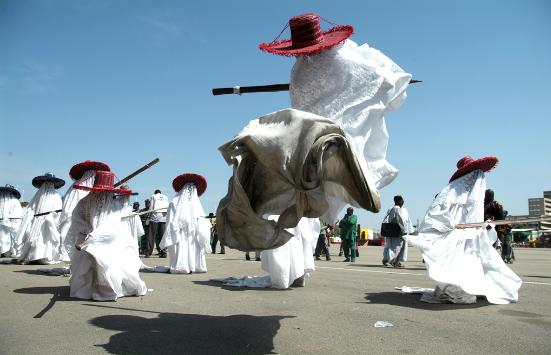
A regional festival that is unique to the city of Lagos, Eyo festival stems from ancient Yoruba history and is speculated to be the inspiration for the modern day Rio de Janeiro carnival in Brazil. The festival features a major parade with participants dressed in while flowing robes that cover their entire body, top hats and sticks; and masquerades referred to as “Eyo” as well as costumed dancers. One of the major objectives of the festival is to pay homage to the Oba of Lagos as well as. The 24-day event sweeps through the entire city with focus on the Lagos Island and attracts a large number of tourists from around the world.
OSUN-OSHOGBO FESTIVAL
A highly cultural and spiritual festival held annually in Osun State, the Osun-Oshogbo festival is held between the months of July and August and sees thousands of Osun worshippers, observers as well as tourists from all over the world who come to join in on the festivities. Celebrated at the Sacred Osun grove in honour of the river goddess, Oshun of Osun State, the event spans for two weeks. The first stage features the ‘Iwopopo’ – a traditional cleansing of the land- at the initial stage, ‘Ina Olojumerindinlogun’ – the lighting of the 500-year-old sixteen-point lamp- three days later and finally the ‘Ibroriade’, an assemblage of the crowns of past rulers, and a committee of priestesses. While the colorful parades and parties across the city suggest light-hearted merriment, the Festival is a strong aspect of the Oshogbo culture.
ARGUNGU FISHING FESTIVAL
With an origin traced to the visit of the late Sultan Dan Mu’azu in 1934 who was honored with an akin festival, the Argungu fishing festival has been around for quite some time. The festival, widely popular in Kebbi and Sokoto state areas, is a competitive feast that aims to weigh the fishing skills of the locals. It is usually celebrated between the months of February and March and also marks the end of a farming season. As music, drums and dance envelops the air, anxious participants try to outdo each other in a bid to gain the biggest catch. Other activities, including swimming competitions, bare-hand fishing, canoe racing and wild duck hunting serve as side attractions. At the end of the festival, the winner is hugely celebrated, there is merriment across the towns and the river is sheltered to ensure it yields fishes for the next festival.
THE NEW YAM FESTIVAL
An extremely popular festival that everyone indigenous to the south-eastern regions of Nigeria look forward to very year, The New Yam Festival is locally referred to as Iriji-Mmanwu,Iwa ji, Iri ji or Ike ji, by the Igbo speaking areas in the region. Ripe with masquerades, colorful costumes, cultural dances and displays, the event symbolizes the end of a harvest and the commencement of the next work cycle. The celebration is a highly cultural occasion and unifies the different Igbo communities together as they are essentially agrarian and dependent on yam.

This explains the basics without talking down to the reader. It reads like it was written by someone who actually tried it. On a related creative note, gpt image 2.5 is fun to try for short videos.
Nice to read something that gets to the point without the filler. It is the kind of detail that usually gets left out. Slightly different topic, but ballon d’or ai has been getting a lot of attention lately.
Useful breakdown, especially the part near the end. Hope you keep writing about this. Also worth checking out for fun: rumpelstiltskin ai.
Nice to read something that gets to the point without the filler. Looking forward to more posts in this direction. For a quick creative break, ai creative platform turns a single photo into a short clip.
The practical angle here is what makes this worth reading. Hope you keep writing about this. Also worth checking out for fun: flying car ai video.
Nice to read something that gets to the point without the filler. Looking forward to more posts in this direction. For a quick creative break, ai creative platform turns a single photo into a short clip.
Clear and well organized post, the main points are easy to follow. Looking forward to more posts in this direction. For a quick creative break, ai rap video generator turns a single photo into a short clip.
This explains the basics without talking down to the reader. It reads like it was written by someone who actually tried it. On a related creative note, gpt image 2.5 is fun to try for short videos.
Useful breakdown, especially the part near the end. For anyone into visual content, fergie baby harlem walk ai is worth a look.
Straightforward write-up, the structure makes it quick to scan. It reads like it was written by someone who actually tried it. On a related creative note, roadster ai video is fun to try for short videos.
The article highlights the Eyo Festival in Lagos as a standout among Nigeria’s top annual festivals, noting its unique white-clad masquerades and deep cultural roots. It also mentions the Osun-Osogbo Festival, which draws devotees and tourists to the sacred grove each year. These details make the list feel grounded in real traditions rather than generic tourism fluff. For a quick visual take on that same festival energy, hotel lobby video offers a way to turn a single photo into a short clip.
The article highlights how Nigeria’s festivals reflect deep cultural and historical roots, with the Osun-Osogbo festival standing out as a UNESCO-recognized event that draws visitors from across the globe. It’s striking that the piece frames these celebrations not just as entertainment but as living archives of community identity and spiritual continuity. That perspective makes the list feel less like a tourist guide and more like a cultural study, which is refreshing. For anyone who enjoys exploring themed event worlds, azeroth survivors download offers a similarly immersive seasonal experience.
Nigeria’s festival calendar clearly extends beyond the well-known Durbar and Eyo displays. The piece helps explain how events like the Osun-Osogbo festival mix spiritual observance with public celebration, which is often missing from quick tourism summaries. It also notes that timing varies by community, so visitors should not treat these as a single national season. For a similar mix of culture and eerie transformation, the zombie ai trend page offers photo-based zombie clips.
The article highlights the Eyo Festival as one of Nigeria’s top annual events, noting its deep roots in Lagos Island and the striking white costumes worn by participants. It also mentions the Osun-Osogbo Festival, which draws crowds to the sacred grove and blends cultural ritual with modern celebration. These details show how Nigerian festivals carry both historical weight and living energy. For turning a single photo into a head-bop animation, head bop ai offers a quick way to echo that festive spirit.
The article’s ranking of Nigeria’s top annual festivals highlights how each celebration carries distinct regional roots, which makes the list more than just a tourist guide. I found the inclusion of the Argungu Fishing Festival especially notable, since its history and riverside setting give it a character that can’t be replicated indoors. The description of the Eyo Festival also stood out for how it links Lagos tradition with the city’s evolving identity. For anyone who enjoys learning how game events borrow from real cultural rhythms, how to play azeroth survivors covers a different kind of recurring challenge.
The article highlights how Nigeria’s festival calendar reflects deep cultural and religious diversity rather than simply copying Italy or Brazil. For instance, the Osun Osogbo festival draws devotees and tourists to the sacred grove each year, showing how tradition and community identity remain central. That focus on survival through shared rituals reminds me of another kind of wave-based endurance in azeroth survivors game.
The piece makes a fair point that Italy and Brazil aren’t the only countries with vibrant festival cultures, and it’s refreshing to see Nigeria’s celebrations get that recognition. The Durbar festival stood out most, especially since the article notes it marks both the end of Ramadan and the start of the Islamic calendar year. That dual significance gives it a depth beyond just spectacle, which the description captures well. A similar sense of progression and picking your starting identity shows up in poke survivor browser game.
Nice to read something that gets to the point without the filler. It reads like it was written by someone who actually tried it. On a lighter note, if you grew up on Pokémon, daily red pokemon has a quick daily battle against Red.
Straightforward write-up, the structure makes it quick to scan. It is the kind of detail that usually gets left out. Slightly different topic, but ozil goal ai has been getting a lot of attention lately.
Nice to read something that gets to the point without the filler. Looking forward to more posts in this direction. For a quick creative break, ozil goal ai turns a single photo into a short clip.
The article highlights five major Nigerian festivals, and the detail about the Argungu Fishing Festival’s competitive fishing tradition stood out as a genuine cultural spectacle rather than a staged event. It also usefully notes how each festival carries distinct regional and historical significance, which helps readers understand Nigeria’s cultural diversity beyond a surface level. For anyone exploring seasonal visual trends tied to such celebrations, pumpkin head ai trend offers a relevant reference point.
The piece rightly puts Nigeria’s festivals on the map alongside Italy and Brazil, and the Osun Osogbo festival’s two-week ritual cleansing of the river stands out as a detail worth remembering. It also makes a strong case that the Eyo masquerade’s white-clad figures are more than spectacle, since they honor departed members of the community. Still, the list leaves out northern celebrations like the Durbar, which many travelers consider equally iconic. For a closer look at modern takes on Nigerian festival energy, gas station dance offers a fitting next step.