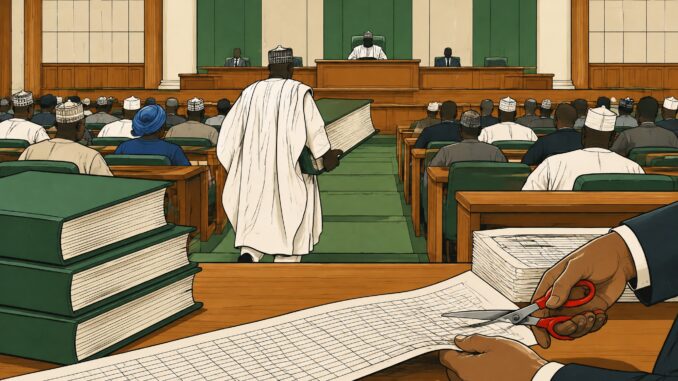

ABUJA, Nigeria – President Bola Tinubu has asked the National Assembly to repeal and re-enact the 2026 Appropriation Act, reducing total federal spending from N68.323 trillion to N65.176 trillion, a cut of N3.147 trillion.
The request was contained in a letter dated November 20, 2026, which the Speaker of the House of Representatives, Abbas Tajudeen, read at plenary on Tuesday, November 24, Premium Times reported. The Speaker referred the bill and the revised fiscal framework to the House Committee on Appropriation. P.M. News reported that the Senate President, Godswill Akpabio, presented the same correspondence in the Senate on the same day.
The revised figures
The official summary of the House sitting, published by the National Assembly Library Trust Fund, put aggregate expenditure at N65.176 trillion and projected revenue, including government-owned enterprises, at N33.720 trillion. Capital expenditure is N26.232 trillion. The fiscal deficit, including project-tied loans, is N31.457 trillion, or 5.64% of gross domestic product.
The deficit is unchanged from the budget the President signed on April 17, 2026, according to Premium Times and Nairametrics. Planned borrowing also stays at N29.218 trillion, made up of N18.428 trillion from domestic sources and N10.790 trillion from foreign sources. The letter valued a $7.7 billion external loan at about N10.368 trillion, using a conversion rate of N1,346.50 to the dollar.
Mr Tinubu told lawmakers the revision would regularise spending that NNPC Limited incurred on behalf of the Federation, cover debt service that was under-provided, recognise capital warrants already issued and provide refunds to ministries, departments, agencies and special accounts. New provisions cover road projects, agriculture and water vulnerability.
External borrowing approved
On the same day, the House approved external borrowing of $20.52 billion and €1.04 billion for the 2026 to 2027 fiscal period to part-finance the deficit, the plenary summary showed. The Senate also approved the plan after a report from its Committee on Local and Foreign Loans. P.M. News and other outlets reported the Senate figures as $20.517 billion and €1.45 billion, a euro amount that differs from the House summary. The reports did not give a breakdown by lender.
The 2026 budget began as a N58.18 trillion proposal presented on December 19, 2025. The National Assembly passed it at N68.323 trillion on March 31, 2026.
For contractors and suppliers to government, the letter said most capital allocations to ministries and agencies consist of amounts for which warrants have already been issued, which leaves little room for new projects outside the named sectors. For businesses and savers, domestic borrowing of N18.428 trillion keeps the Federal Government as a large borrower in the market where banks, companies and state governments also raise money.
The House Committee on Appropriation will consider the bill next, and no date has been announced for its report. The President is expected to present the 2027 budget to the National Assembly before the end of December, P.M. News reported.
Sources
Premium Times via AllAfrica, November 24, 2026

Be the first to comment